

The core principle of hydrogen rich water cup: electrolytic water technology
The core technology of the hydrogen rich water cup is actually electrolysis of water. Simply put, it is to decompose water (H ₂ O) into hydrogen gas (H ₂) and oxygen gas (O ₂) through electric current, and then dissolve the hydrogen gas into water to form the so-called "hydrogen rich water".
1. Electrolysis process
There is usually an electrolysis module at the bottom or inside of the water cup, which contains two electrodes (positive and negative). After being electrified, water molecules undergo a chemical reaction under the action of the electrode:
Negative electrode (cathode): produces hydrogen gas (2H ₂ O+2e ⁻ → H ₂↑+2OH ⁻).
Positive electrode (anode): produces oxygen (2H ₂ O → O ₂ ↑+4H ⁺+4e ⁻).
Hydrogen will dissolve into water, while most of the oxygen will be expelled (some water cups may be designed with exhaust holes).
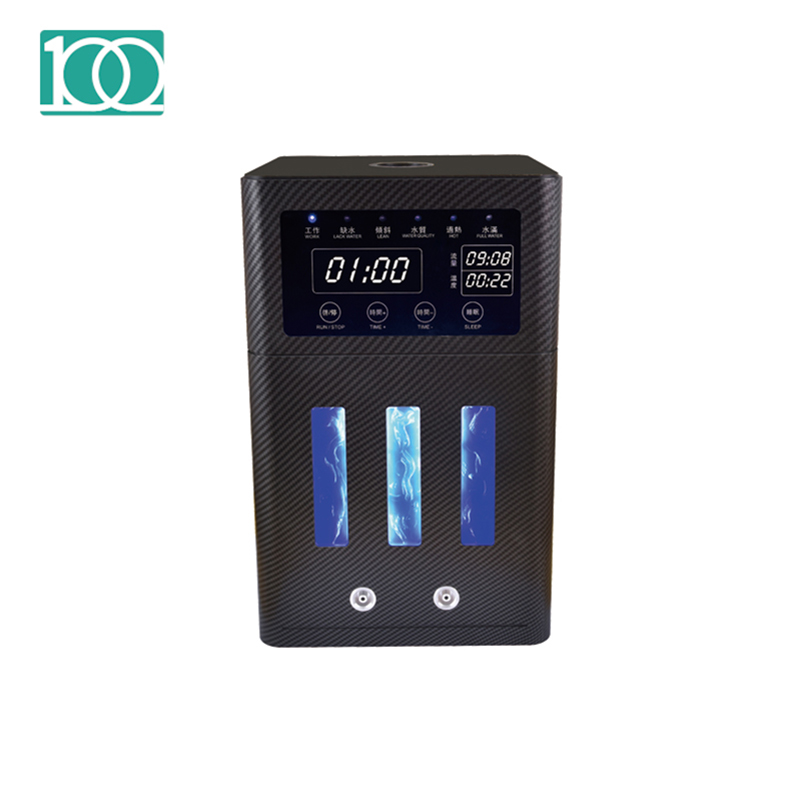
2. Dissolution and preservation of hydrogen gas
The hydrogen produced by electrolysis will merge into water in the form of tiny bubbles, but hydrogen itself is difficult to dissolve in water (with a solubility of about 1.6 mg/L at room temperature), so high-end water bottles will improve dissolution efficiency through the following methods:
Pressure dissolution: Some water cups will briefly seal the cup body, increasing pressure to force more hydrogen gas to dissolve in water.
Nanobubble technology: Breaking hydrogen gas into extremely small bubbles to extend its residence time in water.
3. Safety design
Due to the flammability of hydrogen, hydrogen rich water bottles are usually treated safely:
Concentration control: The hydrogen concentration should be controlled below 4% (far below the lower explosive limit of 4.6%).
Automatic power-off: Automatically stops after electrolysis is completed to avoid excessive gas production.